You have been hearing about AI for months. Maybe years. It shows up in every newsletter, every conference agenda, and every conversation with someone who seems very excited about something you have not quite had time to look into yet.
And if you are being honest, part of you wonders whether you are already behind.
You are not. But you are at a decision point that matters, because the way most small business owners approach AI for the first time determines whether it becomes a genuine advantage or an expensive distraction. The difference between those two outcomes is not about which tools you choose. It is about how you evaluate them before you commit.
This is a guide for doing that well.
Why So Many AI Implementations Fail
Before we talk about what to look for, it helps to understand why so many AI tools end up unused six months after they were introduced with so much enthusiasm.
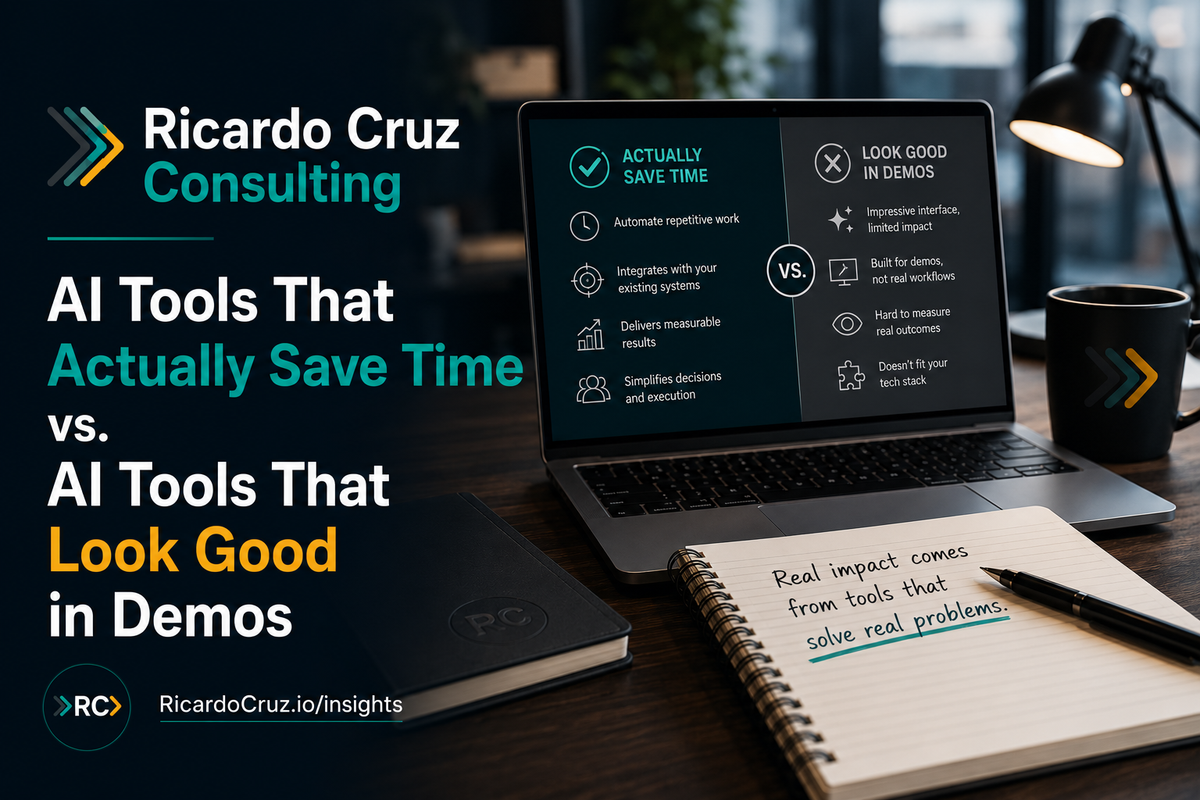
The most common story goes like this. A business owner sees a demo. The demo is impressive. A polished presenter shows a tool doing something that appears to save hours every week. The owner buys a subscription, introduces it to the team, and waits for the transformation to take effect.
What happens next is almost always the same. The tool works differently in the real operation than it did in the demo. The team finds workarounds instead of adopting the new workflow. The subscription renews automatically for several months before anyone notices it is not being used. Eventually, someone cancels it, and the experience becomes a reason to be skeptical of the next tool that comes along.
The tool was probably not bad. The evaluation process was.
A demo is designed to show a tool at its best under ideal conditions, with prepared data, and with a presenter who has practiced the workflow hundreds of times. Your operation is not a demo. It has legacy processes, inconsistent data, team members with varying levels of comfort with technology, and approximately zero time for a lengthy transition period.
The tools that survive that reality are built differently from the ones that shine in demos. Here is how to tell them apart.
The Five Criteria That Actually Matter
1. It solves a problem your team feels every day
The strongest signal that an AI tool will get adopted is that it addresses a problem your team feels frustrated by daily. Recognizing this makes owners feel understood and encourages practical focus.
Before evaluating any tool, write down the three workflows in your business that consume the most time for the least strategic value. Those are your targets. Any tool that does not directly address one of them is solving someone else's problem, not yours.
2. It fits inside workflows your team already uses
The fastest way to kill adoption is to ask your team to go somewhere new to do something they already do somewhere else. Tools that require your team to switch platforms, log in to a separate system, or learn an entirely new interface face an adoption hill that most small-business teams will not climb, regardless of how capable the tool is.
The AI tools that succeed are those that integrate seamlessly into the software your team already uses. Ask vendors about compatibility with your current platforms, like email, scheduling, or project management tools, to ensure smooth adoption and avoid workflow disruptions.
3. A non-technical team member can use it within one week
This is a practical test, not a theoretical one. Before committing to any tool, identify the team member who is least comfortable with new technology and ask honestly: could this person use this tool effectively after one week, without ongoing hand-holding?
If the answer is no, the tool is probably built for a larger organization with dedicated IT support and a formal training program. That is not a criticism of the tool. It is a mismatch for where you are right now. The best AI tools for small businesses are designed for real people doing real jobs, not for power users who enjoy figuring things out.
4. The time savings are visible within 30 days
Sustainable adoption depends on tangible results within 30 days. Define clear, measurable outcomes-such as reducing task time from three hours to one per week-to track progress and maintain team enthusiasm during the initial rollout.
Before you implement anything, define what success looks like in concrete terms. Not "this should make things more efficient." Something measurable: this task currently takes three hours per week and should take one hour after implementation. That specificity gives you something to point to when the novelty wears off, and the team needs a reason to keep using the new workflow.
5. You can explain what it does without using the word "AI."
This one sounds simple, and it is genuinely revealing. If you cannot describe what a tool does in plain language, without referencing the technology behind it, you probably do not have a clear enough picture of its actual function to evaluate whether it fits your operation.
The best AI tools do something specific and describable. They draft email responses based on your previous replies. They automatically transcribe and summarize meeting notes. They route incoming requests to the appropriate team member based on the message's content. Every one of those descriptions tells you exactly what the tool does, what it replaces, and what your team gets back.
If the best description available is that it uses AI to make your business smarter, keep looking.
A Simple Evaluation Framework
When you are ready to assess a specific tool, run it through these four questions before you spend a dollar or an hour of your team's time.
First: what specific task does this replace, and how long does that task currently take per week? If you cannot answer this question with a number, the potential ROI is not yet defined.
Second: Which team members would use this daily, and what is their current comfort level with new tools? Adoption is as much a people problem as a technology problem.
Third: What does implementation require? How long, who needs to be involved, and what breaks in your current workflow during the transition? The transition cost is real, and it belongs in the evaluation.
Fourth: What does the first 30 days look like if this works, and what does it look like if it does not? Having an exit criterion before you start is not pessimism. It is good operational judgment.
Where to Start If You Are Starting from Zero
The most effective first AI implementation for most small businesses is rarely the most ambitious one.
Start with the workflow that is most repetitive, most time-consuming, and least dependent on complex judgment. Look for the task your team does the same way every time, with the same inputs producing the same outputs. That predictability is what makes a workflow a strong candidate for automation.
Get that one thing working well. Let your team experience the time savings firsthand. Build confidence and appetite for the next implementation from real experience, not from a demo or a promise.
The businesses that build genuine AI advantages are not the ones that implement the most tools the fastest. They are the ones who carefully implemented the right tools, measured the results honestly, and expanded on a foundation of what actually worked.
That is how you build something that lasts past the first renewal date.
Ricardo Cruz is an AI Operations Consultant and Fractional COO based in Carmel, Indiana. He helps small businesses cut through the noise, identify where AI can deliver real operational value, and implement tools their teams will actually use. If you are ready to figure out where AI fits in your operation, a 30-minute discovery call is a good place to start.