There is a version of your business that runs without you in every conversation, every decision, and every fire drill. Where the team knows what to do, handoffs happen cleanly, and growth does not require you to work harder every single quarter to stay even.
Most business owners can picture that version. Very few know how to build it.
A Fractional COO is one path to getting there. But it is not the right path for every business at every stage. This post is an honest look at what a Fractional COO actually does, when bringing one in makes sense, and when it does not.
What a Fractional COO Actually Does
Before you can evaluate whether you need one, it helps to understand what the role entails and what it does not, including how a Fractional COO embeds in your business and builds systems that last.
A Fractional COO is not a consultant who shows up, runs an assessment, hands you a 40-page report, and disappears. That model has its place, but it is not this.
A Fractional COO embeds in your business. They learn how it actually runs, not how it looks on an org chart. They sit in on the meetings that matter, talk to the people doing the work, and build a clear picture of where the operation is working and where it is quietly falling apart.
Then they fix it. Not by telling you what needs to change. By building the systems, the processes, and the accountability structures that make the change stick after they step back.
The engagement ends when your team can independently own the operation. That is the goal from day one.
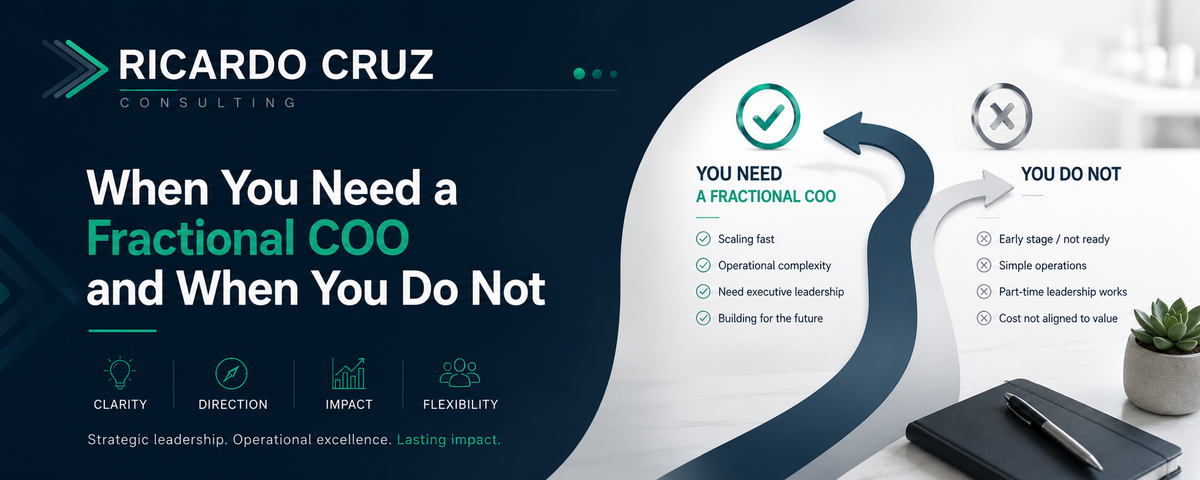
Four Signs You Are Ready for a Fractional COO
You are the operational bottleneck in your own business, which indicates it might be time to consider a Fractional COO to build decision frameworks.
If decisions slow down or stop when you are unavailable, that is not a sign of how important you are. It is a sign that the operation depends on your direct involvement to function. A Fractional COO builds the decision frameworks and escalation paths that let your team move without waiting for you.
If growth is outpacing your operational capacity, it's a common challenge that a Fractional COO can help you manage smoothly, making you feel understood and supported during this transition.
Revenue is increasing. Headcount is increasing. And somehow the chaos is increasing faster than both. This is one of the most common inflection points where a Fractional COO creates immediate value. Growth without operational infrastructure does not scale. It just gets more expensive to manage.
You keep solving the same problems.
If the same issues surface in your business every quarter, the problem is structural, not situational. A Fractional COO does not put out fires. They redesign the system so the fires stop starting in the first place.
You are preparing for something significant.
A funding round. A major new client. A geographic expansion. An acquisition. Any of these requires your operation to be documented, predictable, and transferable. If it is not, the risk is real, and the cost of finding out at the wrong moment is high. A Fractional COO builds the operational foundation that keeps those moments going well rather than sideways.
Three Signs You Are Not Ready Yet
Being honest about fit matters as much as recognizing opportunity.
If your processes are still evolving and lack clarity, it's natural to feel uncertain. Recognizing this helps you feel more confident about waiting until your operation is ready for a Fractional COO.
Suppose your business is still in its earliest stage, where the model is being tested, and workflows change week to week; bringing in a Fractional COO is premature. The role is most valuable when there is an operation to improve, not when you are still figuring out what the operation should be. At that stage, the work is founder-led by design.
The problem is strategy, not execution.
A Fractional COO is an operational leader, not a business strategist. If the core challenge is that you are not sure where to take the business, or which market to pursue, or what the offer should be, that is a different kind of engagement. Operational excellence applied to the wrong strategy gets you to the wrong destination faster.
You are not ready to let someone else lead operationally.
This can be difficult to accept, but trusting someone else to lead operational decisions can empower you and your business to grow more effectively, making you feel confident in your leadership choices.
What the Engagement Actually Looks Like
Most Fractional COO engagements run three to six months, depending on the complexity of the operation and the scope of what needs to be built.
The first two weeks are almost entirely listening. The goal is to understand the business as it actually runs, not as it is described. The gap between those two things is usually where the most important work lives.
From there, the engagement moves into the building phase. Workflows get documented. Accountability structures get defined. The rhythms that keep a team aligned without constant management oversight get put in place. And then the team gets trained to operate inside those systems with confidence.
The engagement closes with a structured handoff. Everything is documented. The team knows how it works. And there is a follow-up cadence in place to address any issues that arise after the Fractional COO steps back.
The measure of a successful engagement is not whether the business needed the Fractional COO. It is whether it still needs them six months later. It should not.
The Question Worth Sitting With
Before you decide whether a Fractional COO is the right next move, sit with this question for a moment.
If you stepped away from your business for two weeks tomorrow, with no access to email or phone, what would happen?
If the honest answer is that things would fall apart, that is not a judgment. It is information. It tells you that your operation currently depends on your direct involvement to function, and that the gap between where you are and where you want to be is operational rather than strategic.
That gap is exactly what a Fractional COO is built to close.
Ricardo Cruz is a Fractional COO and Operations Consultant with 15+ years of enterprise operations experience at Fidelity Investments. He helps founder-led service businesses install the operating systems, accountability, and decision frameworks needed to grow without routing every issue through the founder.
Continue exploring
The Founder Dependency guide explains the structural problem this role is designed to solve. The free Growth Capacity Assessment can help determine whether the business is ready for embedded operational leadership.