An athletic performance center owner came to me with the kind of problem that looks like success from the outside.
Every session booked. High-end clients. Personal training at a premium price point. Revenue healthy. By any normal measure, the business was working. But he was spending 10 hours a week manually reviewing client performance data and writing personalized nutrition and feedback notes by hand, on top of everything else it takes to run a gym.
The work wasn't optional. His entire positioning depended on that personal touch. But the way he was delivering it had quietly become the thing standing between him and any further growth.
Full books, zero breathing room
Here's the math that made the real cost visible. At $150 per training session, every hour he spent hand-writing feedback notes was an hour he wasn't available to train, or to build the next cohort of clients he actually wanted to take on.
10 hours a week of admin, multiplied by $150 an hour, multiplied across a working year: $72,000 in annual training capacity that existed only on paper, because the time to deliver it was already spoken for by manual review work.
He wasn't short on demand. He was the bottleneck standing between every client and the feedback they were already paying for.
What we actually built
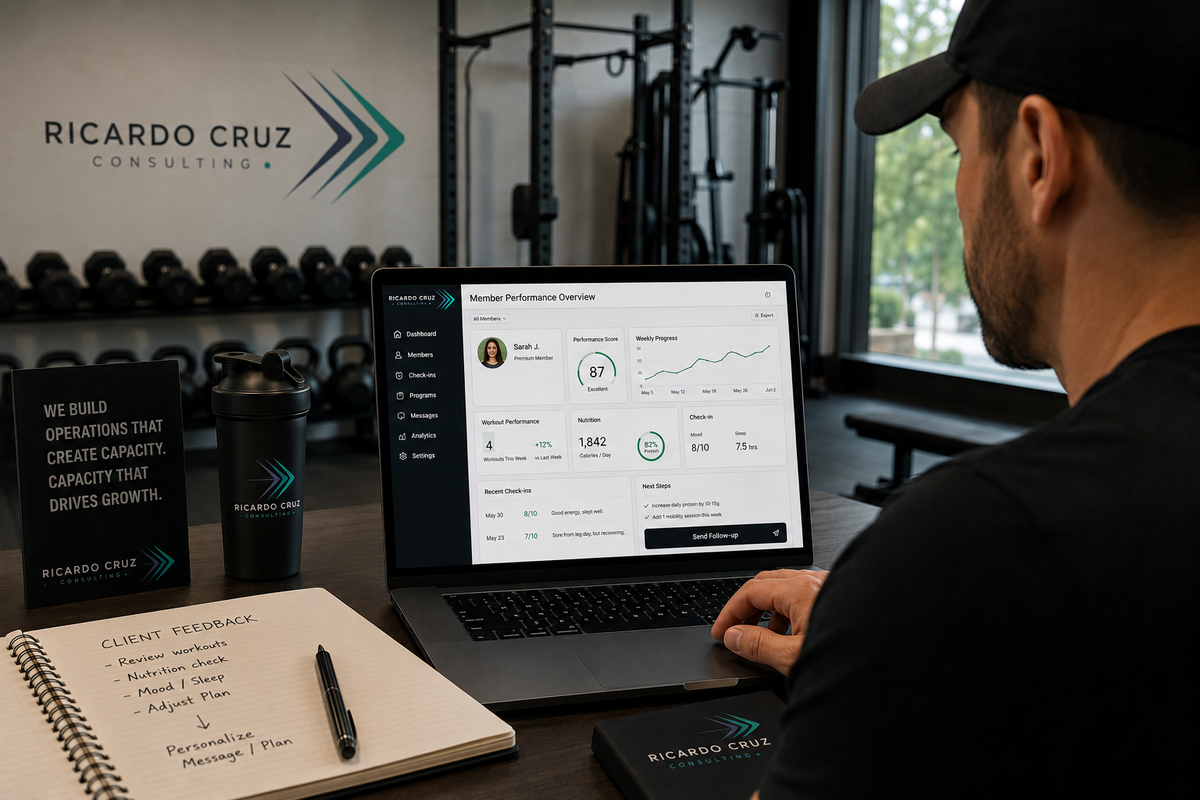
The fix wasn't more software stacked on top of the same habits. It was one connected dashboard, built over six weeks, that changed where the manual effort actually lived.
Members now log their own data directly: workout results, nutrition stats, weekly mood check-ins. It takes them about two minutes. It used to take him ten.
The system synthesizes every input automatically into a single performance view per member, updated in real time. No more flipping between a dozen spreadsheets and a string of texts to piece together how someone was actually doing.
He can trigger a personalized follow-up with one click: a push notification, an action plan, a coaching prompt. The system handles delivery. He handles the part that actually requires his judgment.
Automated check-in sequences run between sessions, so no client goes more than a week without contact, even during his busiest stretches.
What changed for him, specifically
Client follow-up time dropped from 10 hours a week to 1. He reclaimed 40 hours a month without lowering the quality of what clients experienced. If anything, clients reported faster, more consistent feedback than before, because it no longer depended on him finding a free hour between sessions.
At $150 a session, 40 reclaimed hours a month works out to $72,000 in training capacity that simply didn't exist before. That capacity is now going toward a second cohort of premium clients, growth that was structurally impossible under the old way of working, because there was no time left to give it.
The part worth sitting with
His calendar was never the problem. A full calendar can still hide a business that's quietly out of capacity, because being busy and having room to grow are two different things.
The fix wasn't to spend the 10 hours more efficiently. It was to separate the parts of that time that actually needed his judgment from the parts that were just moving data from one place to another. Once those were split apart, the system could handle one of them entirely on its own.
Ricardo Cruz is a Fractional COO and Operations Consultant with 15+ years of enterprise operations experience at Fidelity Investments, including a documented 90% reduction in escalations through process redesign. He works with founder-led service businesses to recover time currently lost to manual administrative work.
Continue exploring
See how capacity, flow, and margin connect in the Operational Efficiency guide, and use the Workflow Automation guide to evaluate which parts of a high-touch client experience should be automated.
For ongoing support improving connected workflows, explore the Automation Optimization Retainer.