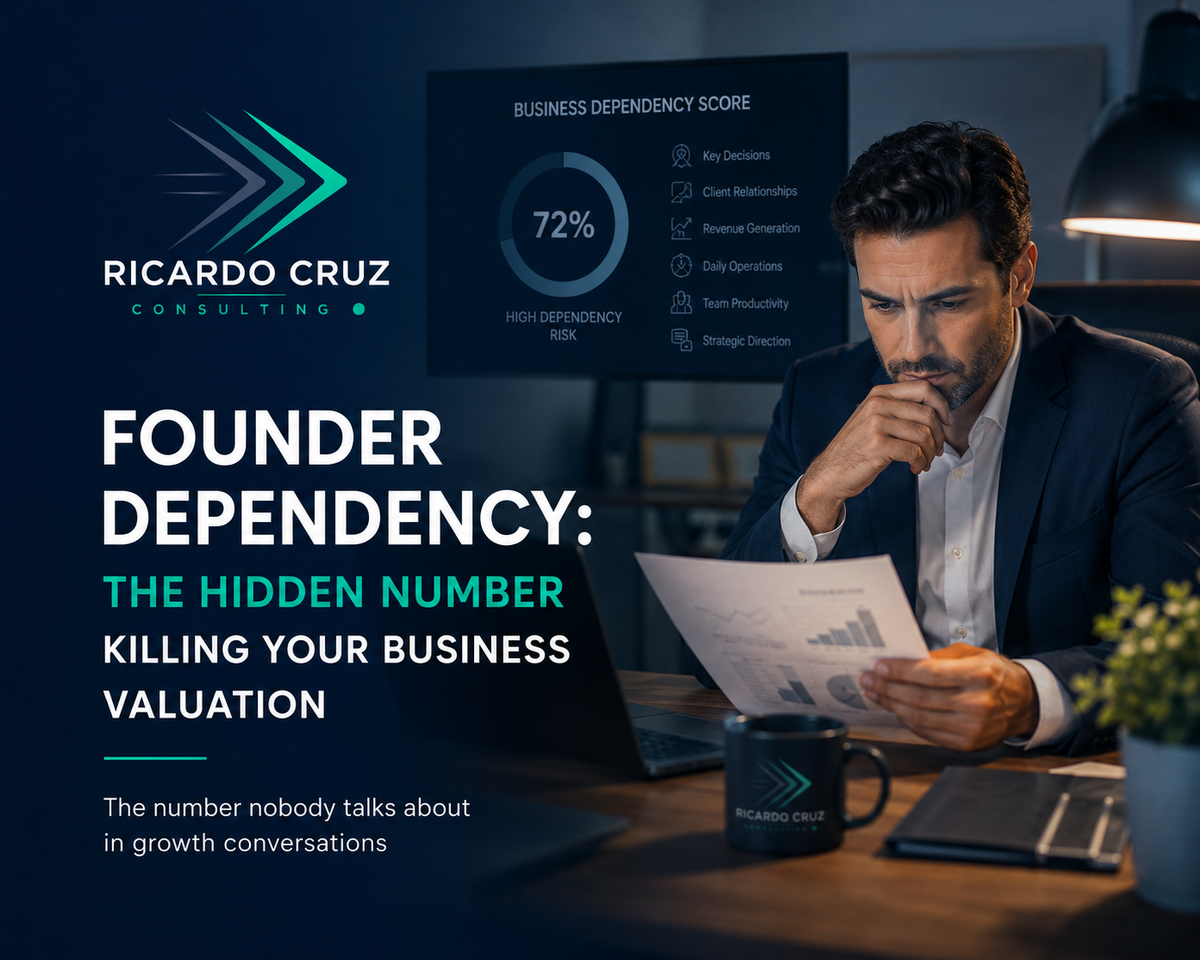
The number nobody talks about in growth conversations
Every founder tracks revenue. Most track margin. Few track the number that matters most when it's time to raise capital, bring on a partner, or eventually sell: how much of the business depends entirely on one person.
Call it founder dependency. It's the single biggest unspoken risk in a growing SMB, and it's almost never discussed until an investor or buyer asks the question directly. By then, it's too late to fix quickly.
What founder dependency actually looks like
It rarely looks dramatic. It looks like a normal Tuesday.
A client question that has to wait for the founder to reply. A new hire who can't be onboarded properly because the process lives in someone's memory, not a document. A decision that gets delayed two days because the one person who can make the call is in back-to-back meetings.
None of these moments feel like a crisis individually. Together, they describe a business that cannot run a single day without the founder in the room.
Why this is exhausting the people building these companies
Recent research backs up what most founders already feel in their bodies. One in three European CEOs considered stepping away from their own company in the past year. Burned-out founders see measurable drops in productivity, and they miss funding opportunities at higher rates than founders who aren't carrying that weight.
The instinct is to treat this as a personal failing. Work harder. Sleep less. Push through.
But burnout in a founder-dependent business isn't a stamina problem. It's what happens when one person is structurally required for the business to function, and that person eventually runs out of hours in the week.
The cost shows up twice
This pattern costs a business in two separate ways, and most founders only see one of them.
The first cost is daily. Every approval, every question, every piece of tribal knowledge that only lives in the founder's head slows the business down and exhausts the person at the center of it.
The second cost shows up later, and it's larger. Investors and buyers price founder dependency directly into valuation. A business that cannot operate without its founder for even thirty days is a riskier asset than one that can. That risk gets reflected in the number on the offer, or in whether an offer comes at all.
What actually fixes this
The fix isn't adding headcount. Hiring into an undocumented business usually adds another person who needs the founder to function, rather than removing the founder from the equation.
The fix is structural. It starts with identifying every decision, approval, and piece of knowledge that currently requires the founder personally. Each one gets documented, assigned an owner, or automated. The goal isn't to make the founder less involved emotionally. It's to make the business capable of running a normal day without the founder physically present.
This is slower and less glamorous than hiring. It's also the only version of growth that holds up under real scrutiny, whether that scrutiny comes from an investor, a buyer, or simply a founder who wants a vacation that doesn't involve checking their phone every twenty minutes.
Where to start
The honest first step is an audit, not a hire. Map every place in the business where things currently wait on you specifically. That list is usually longer and more revealing than founders expect.
The free Growth Capacity Assessment takes about ten minutes and shows whether founder dependency, unclear ownership, or process friction is creating the greatest constraint.
Continue exploring
The broader Founder Dependency guide explains how knowledge, decisions, relationships, and coordination become concentrated around the founder. The Fractional COO Engagement is designed for businesses ready to transfer that operating responsibility into durable systems.