A spa owner I worked with was the most skilled person in her own business, and that was the problem.
She ran a local day spa. Booked solid. Clients loved her. By every visible measure, the business was working. But she was spending more than 20 hours a week on tasks that had nothing to do with the work she was actually trained and licensed to do. Writing down client product orders on sticky notes. Walking to the back room to check inventory by hand. Logging into a supplier portal to place orders whenever she remembered to. Then, at the end of every day, manually entering every transaction from her point-of-sale system into QuickBooks, one line at a time.
Three nights a week, she stayed late just to catch up on admin she'd fallen behind on during the day.
The number that changed the conversation
When I ran the audit, the real cost wasn't the 20 hours itself. It was what those 20 hours represented.
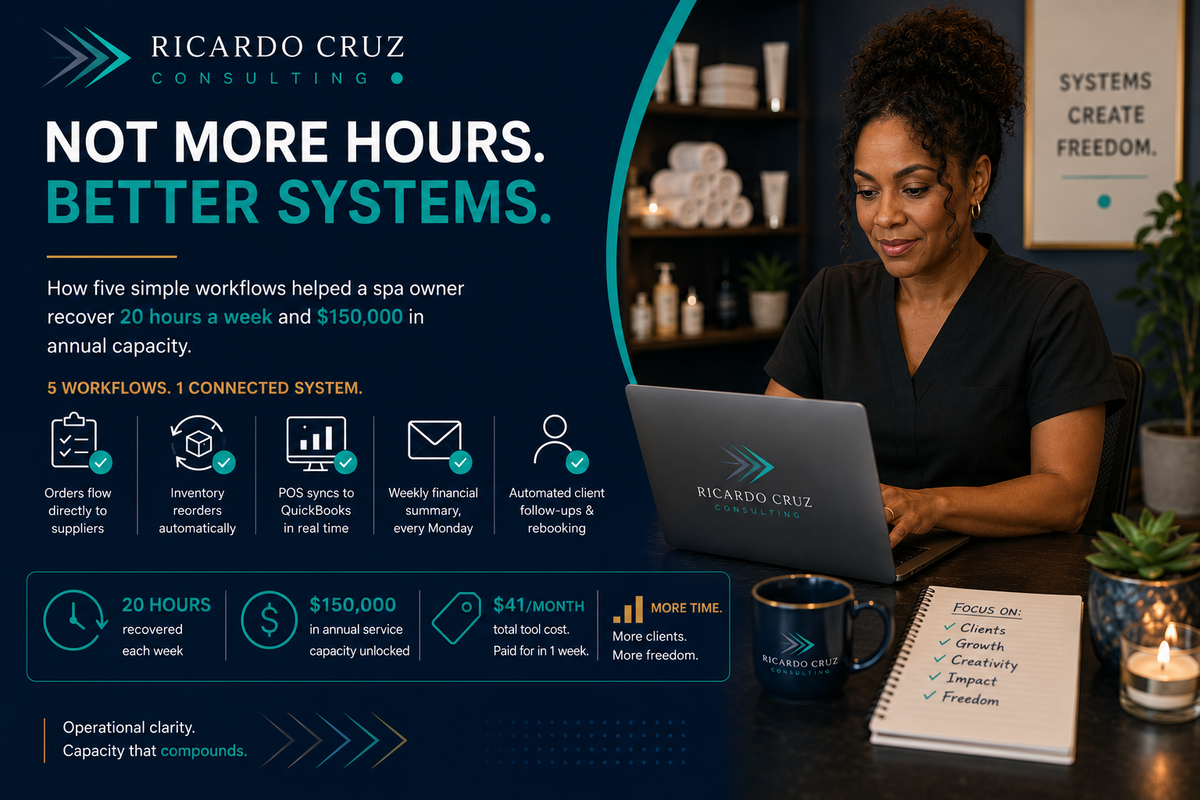
She charges roughly $150 per service hour. She is the highest-value person in her own building. Every hour she spent on inventory and bookkeeping was an hour she wasn't delivering a facial or a massage, which meant it was an hour of revenue capacity that simply didn't exist. Multiply 20 hours a week by $150 by 50 working weeks, and the number lands at $150,000 in annual service capacity blocked entirely by manual administrative work.
Not some of it. All of it. Every dollar of that capacity was sitting behind a sticky note and a supplier login.
What we actually built
This wasn't a new piece of software bolted onto a broken process. It was five small workflows, connected to each other, built over four weeks.
Client product orders now flow from a simple checkout form directly to her supplier. The client gets a confirmation automatically. She gets one daily digest instead of a stack of sticky notes. No phone calls required.
Wholesale inventory reorders itself once stock hits a set minimum. Anything under $200 goes out automatically. Anything larger waits for one tap of approval on her phone, so she still has control without doing the legwork.
Every POS transaction syncs to QuickBooks the moment it happens. No more end-of-day data entry. Her books are current in real time, not three nights behind.
Every Monday at 7am, she gets a plain-English financial summary in her inbox before her first client of the week walks in. One email, the full picture, no spreadsheet required.
And every completed service now triggers an automatic follow-up sequence: rebooking prompts, product recommendations, simple check-ins, all without her lifting a finger.
What changed for her, specifically
She leaves on time most nights now. Her books are accurate without her ever touching them. Her clients are getting better, more consistent follow-up than when she was doing it by memory between appointments. And she's recovered enough time to take on 10 or more additional service hours a week, if she chooses to.
The total monthly cost of the tools running all five workflows: $41. The engagement paid for itself within the first week.
Why I'm telling you this
This wasn't a complicated business. It didn't need a 90-day transformation or a new org chart. It needed someone to look at five repetitive tasks and ask a simple question: does this actually require a human making a judgment call, or is a human just doing what a system should be doing instead?
Most of the operational drag I see in founder-run businesses looks exactly like this. Not a crisis. Just a slow, quiet tax on the founder's time that's been running so long it stopped looking like a problem and started looking like Tuesday.
Ricardo Cruz is a Fractional COO and Operations Consultant with 15+ years of enterprise operations experience at Fidelity Investments, including a documented 90% reduction in escalations through process redesign. He works with founder-led service businesses to recover time and capacity currently lost to manual administrative work.
Continue exploring
The Workflow Automation guide explains how to select automation candidates, while the Operational Efficiency guide connects recovered time to capacity and margin.
The Automation Starter Toolkit provides the mapping, prioritization, and ROI tools to identify similar opportunities.