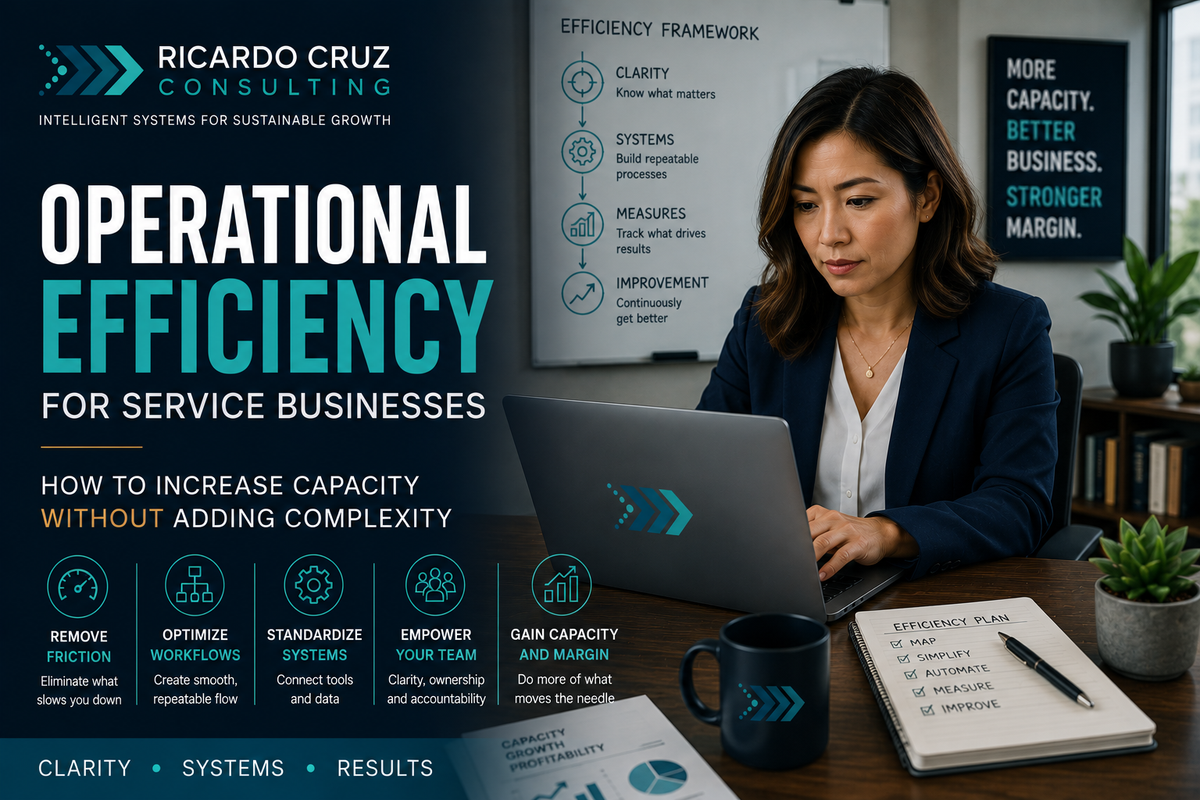
Operational efficiency is the ability to produce a strong business outcome with less delay, rework, confusion, and unnecessary effort.
It is not the same as pushing employees to work faster. It is not a cost-cutting exercise disguised as strategy. It is not a demand that every minute be billable.
For a service business, operational efficiency means that the right work moves to the right person with the information, authority, and systems needed to complete it well.
That creates capacity. The business can serve more clients, improve margins, and reduce founder involvement without adding the same amount of complexity every time revenue grows.
What operational efficiency actually means
An efficient operating system converts time, talent, information, and technology into client value with as little avoidable friction as possible.
The word avoidable matters. Some work requires care, judgment, review, or conversation. A client strategy session should not be treated like a data-entry task. A sensitive approval should not be removed only because it takes time.
The goal is to remove effort that does not protect quality, reduce risk, improve the client experience, or create information the business genuinely needs.
In practical terms, operational efficiency improves five things:
- Flow: work moves without unnecessary waiting or repeated follow-up.
- Clarity: people understand priorities, ownership, and the definition of done.
- Quality: work is completed correctly with less rework and fewer downstream errors.
- Capacity: the team can handle more value-producing work without equivalent increases in headcount.
- Control: leaders can see performance, risk, exceptions, and constraints without reconstructing the business through meetings.
Efficiency is not about removing people from the business. It is about ensuring that skilled people are not consumed by coordination the operating system should already provide.
Operational efficiency vs. productivity
Productivity usually measures how much work a person or team completes. Operational efficiency examines the system that surrounds that work.
An employee can be highly productive inside an inefficient process. They may finish tasks quickly while waiting for approvals, re-entering information, correcting upstream mistakes, attending status meetings, and answering questions that should have been resolved through documentation.
The article It Is Not a Hiring Problem. It Is a Systems Problem. explains why adding people does not solve work that is unclear, duplicated, or poorly designed.
Operational efficiency asks a broader question: how should the system change so capable people can produce better outcomes with less friction?
Why service businesses become inefficient as they grow
Most service businesses do not begin with a designed operating system. They begin with expertise, relationships, and the founder's willingness to solve whatever appears.
That model can support early growth because the founder carries context across the company. They remember client preferences, interpret exceptions, notice missing information, approve decisions, and connect one department to another.
As volume increases, the same model creates hidden operating costs.
Common symptoms include:
- Every client or project is handled as a special case.
- Important information lives in inboxes, chats, and individual memory.
- Teams use several systems but still depend on spreadsheets for status.
- Senior employees become permanent translators between departments.
- Approvals accumulate even when the underlying risk is low.
- Meetings are used to discover what is happening rather than make decisions.
- Revenue increases while margin, responsiveness, or founder capacity declines.
- New hires add coordination needs before they add meaningful capacity.
These are not isolated inconveniences. Together they indicate that the business is spending too much of its capacity managing the work instead of delivering value.
The five sources of operational inefficiency
Most operating friction can be traced to five connected sources.
1. Unclear work
The process has never been defined well enough for people to follow it consistently. Required inputs, decision rules, handoffs, exceptions, and completion standards may differ by employee.
2. Unclear ownership
Several people contribute to the work, but nobody owns the full outcome. Tasks may be assigned without the authority required to move the process forward.
3. Fragmented information
Employees spend time finding, validating, re-entering, or reconciling information. Different systems may contain different versions of client status, project stage, or next actions.
4. Excessive coordination
The process depends on reminders, check-ins, status requests, and personal follow-up. Coordination becomes a hidden job performed by founders, operations leaders, and senior employees.
5. Poorly placed controls
Some work receives too little review while routine work receives too much. Historical approvals remain in place after the risk has changed, turning leaders into permanent bottlenecks.
How to recognize the real operational constraint
Efficiency work should begin with the constraint that most limits the business, not with the process that is easiest to change.
A constraint is the point that determines the rate at which the larger system can produce its intended outcome.
For a service business, the constraint may be lead qualification, contracting, onboarding, a specialist review, founder approval, delivery handoffs, billing confirmation, or client communication.
The guide How to Break Through a Small Business Growth Plateau Without Hiring examines how structural constraints create recurring growth plateaus.
The RCC operational efficiency method
At Ricardo Cruz Consulting, operational efficiency is treated as an operating-system problem. The work follows seven stages.
1. Define the outcome
Start with the business or client outcome the process must produce. Avoid beginning with a task, department, or tool.
2. Measure the current flow
Create a simple baseline using total cycle time, active work time, waiting time, manual touches, handoffs, rework, exceptions, approval time, and founder intervention.
3. Map the work as it actually happens
Document the normal path and the unofficial path. Include the trigger, inputs, steps, decisions, owners, systems, handoffs, controls, exceptions, and finish point.
4. Remove work before optimizing it
Remove duplicate data collection, reports nobody uses, approvals without a current risk purpose, repeated status updates, unnecessary system changes, and meetings that compensate for poor visibility.
5. Clarify ownership and decision rights
Assign ownership for the end-to-end outcome and responsibility for each stage. Define what employees can decide, what thresholds require approval, and what conditions require escalation.
6. Standardize and automate the stable work
The pillar Workflow Automation for Service Businesses explains how to identify a stable workflow and automate it without preserving a broken process.
Automation should support the redesigned operating system. It should not become a substitute for clear work, ownership, or judgment.
7. Review the whole system
Compare the new measures with the baseline and confirm that an improvement in one stage did not create a larger queue, more risk, or a poorer client experience elsewhere.
What to improve first
A strong first efficiency initiative has meaningful business impact, enough repetition to measure, and manageable complexity.
- Lead qualification and sales-to-delivery handoff.
- Client onboarding and information collection.
- Recurring service delivery and quality review.
- Internal approval and escalation routing.
- Project or case status visibility.
- Invoice preparation and billing confirmation.
The free Growth Capacity Assessment can help identify whether the current limit is founder dependency, process friction, unclear ownership, or insufficient operating capacity.
Operational efficiency metrics that matter
An efficiency dashboard does not need dozens of measures. It needs a small set connected to the business problem.
- End-to-end cycle time and waiting time between stages.
- First-time-right completion and rework rate.
- Manual touches, exception rate, and approval time.
- Founder and senior-leader interventions.
- Revenue or gross margin per delivery employee.
- Billing delay and client questions caused by process confusion.
No single metric proves efficiency. Cycle time can improve while quality declines. Utilization can increase while employees lose the capacity to solve problems. The measures should be reviewed as a balanced system.
What operational efficiency is not
It is not maximum utilization
A team operating at full capacity has no room for variation, problem solving, learning, or unexpected demand. Some available capacity protects flow and service quality.
It is not cutting every cost
Removing a control, role, or system may reduce expense while increasing rework, risk, delay, or client loss. Efficiency evaluates total operating value, not one budget line.
It is not automating everything
Automation has maintenance, failure, and governance costs. Low-volume or high-judgment work may remain manual because that is the most efficient design.
The relationship between efficiency, capacity, and margin
Operational efficiency improves economics by recovering capacity that is already being paid for but consumed by avoidable friction.
The article How to Scale Without Hiring More People explores why growth often requires a better operating model before it requires a larger team.
Margin improvement is a result of better system design, not simply lower spending. When the business reduces waiting, rework, coordination, and founder intervention, more of the team's effort reaches the client and the financial outcome.
A practical 30-day efficiency plan
A founder-led service business can begin without launching a company-wide transformation.
- Choose one important client or revenue process.
- Define the complete outcome and process boundaries.
- Record a baseline for cycle time, waiting, rework, handoffs, and founder involvement.
- Map the actual process with the people who perform it.
- Identify the main constraint and the workarounds surrounding it.
- Remove at least one unnecessary step, approval, report, or duplicate entry.
- Clarify ownership and decision rights.
- Standardize the minimum information and completion criteria.
- Automate one stable coordination step where the value is clear.
- Review the result and document the next constraint.
For a structured diagnosis of where time, margin, and capacity are being lost, the Operational Friction Audit identifies the highest-value constraints and creates a prioritized improvement roadmap.
For businesses ready to implement their first systems internally, the Automation Starter Toolkit provides workflow mapping, prioritization, ROI, SOP, and implementation tools.
For ongoing redesign, automation, and measurement across connected workflows, the Automation Optimization Retainer provides continued senior operating support.
Related RCC authority guides
Begin with Operational Debt when the lost capacity comes from accumulated workarounds. Use the Business Process Automation guide for end-to-end redesign and the Workflow Automation guide for the stable repeatable steps that technology can support.