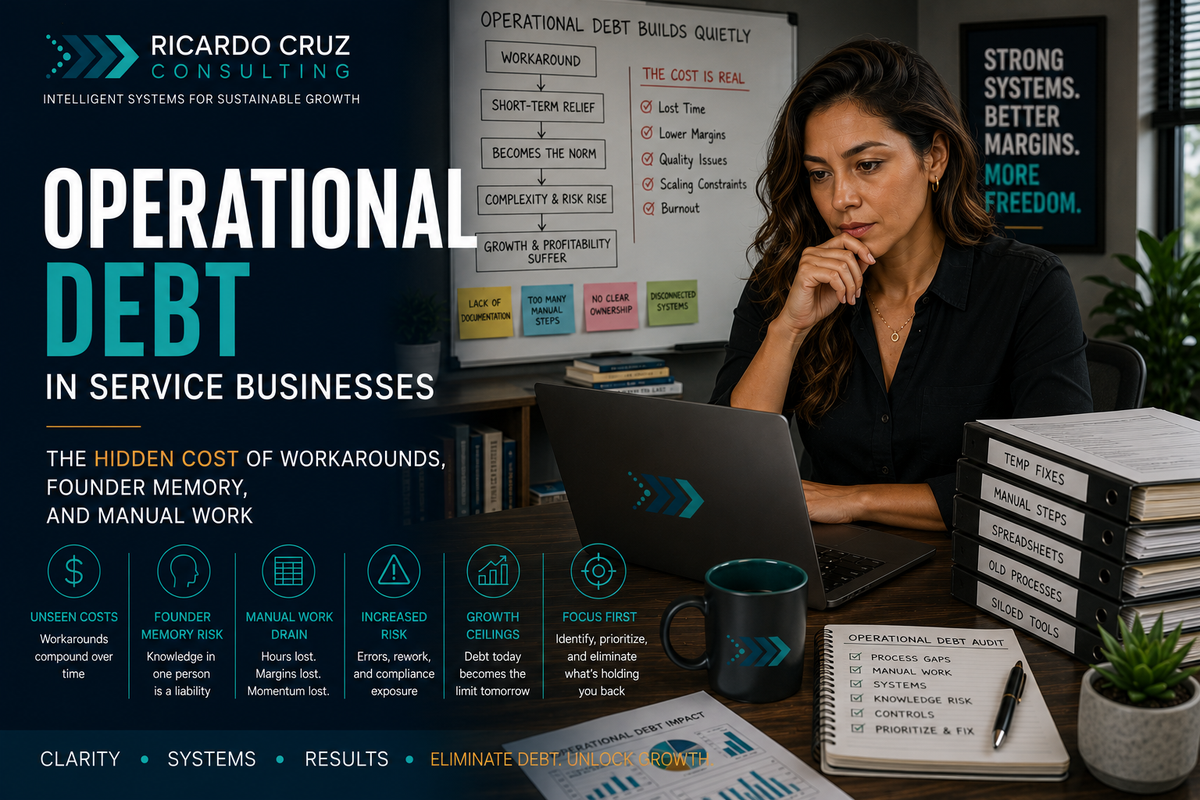
Operational debt is the accumulated cost and risk created when temporary workarounds, undocumented decisions, manual coordination, and disconnected systems become part of how a business operates.
It rarely appears as one dramatic failure. It builds quietly. A spreadsheet is created because the CRM cannot show the status the team needs. A founder approves one unusual request, and the approval becomes permanent. A senior employee remembers how a difficult client must be handled, so nobody documents it. A new tool is added, but the old process is never retired.
Each decision may be reasonable in the moment. Together, they create an operating system that becomes slower, harder to understand, and more dependent on specific people as the company grows.
The core problem is simple: the business keeps paying for yesterday's shortcuts with today's capacity.
What operational debt actually means
Operational debt is similar to technical debt, but it exists across the way the business works. It includes the processes, knowledge, decisions, systems, controls, and handoffs that were never fully designed or maintained.
Debt forms when the business accepts a short-term solution without recording the future work required to make it durable. That does not mean every workaround is a mistake. Early-stage and growing businesses need speed. A temporary spreadsheet, manual approval, or founder-led decision can be the right answer when volume is low and the process is still changing.
The problem begins when temporary work becomes permanent by default.
Operational debt usually has three characteristics:
- It solves an immediate problem.
- It creates a recurring cost, dependency, or risk.
- Nobody has explicitly decided whether to repair, replace, or retain it.
That third characteristic matters. Debt becomes dangerous when it is invisible.
Operational debt versus normal business complexity
Not every difficult process is operational debt. Some work is naturally complex because the service requires expertise, regulation, judgment, or coordination. A clinic may need careful privacy controls. A professional-services firm may require senior review for high-risk recommendations. A construction business may need several parties to approve a change that affects cost and safety.
Complexity becomes debt when the business cannot explain why the complexity exists, who owns it, or whether it still creates value. A necessary control is not debt. An approval that remains only because it has always existed may be. A specialized client exception is not automatically debt. A private workaround known only to one employee is.
A useful test is: if the person who created this process left tomorrow, could the team explain how it works, why it exists, and how to change it safely?
The article What Happens When Your Best Person Calls in Sick shows how quickly hidden knowledge becomes an operating risk when a key employee is unavailable.
How operational debt accumulates
Temporary workarounds become permanent
A temporary process is introduced to meet a deadline, satisfy one client, or bridge a system limitation. The business moves on, but nobody returns to remove or formalize it. Over time, employees build more work around the workaround. What began as a bridge becomes part of the infrastructure.
The founder fills gaps in the operating system
The founder remembers the context, settles conflicting priorities, approves exceptions, and connects information across teams. Because the problem gets resolved, the underlying gap remains hidden. This is one reason founder dependency and operational debt reinforce each other. The founder makes the business appear more functional than its systems actually are.
New systems are added without retiring old work
A CRM, project platform, automation tool, or reporting system is introduced, but the previous spreadsheets, inbox rules, or manual reports remain. The business now pays for both the new system and the old behavior.
Exceptions become the normal path
A process may have been designed for the standard case, but common variations are handled through messages, side conversations, and memory. When exceptions are frequent, they are no longer exceptions. They are evidence that the process does not reflect the real work.
Growth outpaces documentation and ownership
The business adds clients, employees, services, and technology faster than it updates responsibilities and procedures. The work still gets done, but the operating model becomes less visible with every change.
This is why It Is Not a Hiring Problem. It Is a Systems Problem. remains an important principle. Adding people to unclear work can increase the coordination burden instead of removing it.
The six forms of operational debt
1. Process debt
Process debt exists when work contains unnecessary steps, duplicate approvals, inconsistent paths, unclear handoffs, or repeated rework. Typical signs include different employees completing the same service differently, work waiting between departments, and recurring meetings used to reconstruct status.
2. Knowledge debt
Knowledge debt exists when important information lives in individual memory, private notes, inboxes, or undocumented habits. The business becomes dependent on whoever knows the history, the client preference, the supplier exception, or the reason behind a decision.
3. Decision debt
Decision debt exists when authority, thresholds, and escalation rules are unclear. Routine decisions move upward because the team does not know what it can decide. Leaders repeatedly revisit the same questions because prior decisions and principles were not recorded.
4. Technology and data debt
Technology debt exists when systems overlap, integrations are fragile, data definitions conflict, or manual entry connects tools that should work together. The visible symptom is often another spreadsheet. The deeper issue is that the business does not trust its systems or data enough to operate from them.
5. Control debt
Control debt exists when the business lacks the checks needed to protect quality, financial accuracy, client commitments, privacy, or access. It also exists when controls are excessive. Too little control creates risk. Too much control creates delay and teaches employees to work around the process.
6. Capacity debt
Capacity debt is the recurring time consumed by coordination, correction, searching, re-entry, follow-up, and founder intervention. The work may not appear on an invoice or project plan, but it reduces how much client value the team can produce with the people already employed.
The most common signs of operational debt
Operational debt is usually visible through patterns rather than one metric. Common signs include:
- The same questions are answered repeatedly.
- Employees maintain shadow spreadsheets or private task lists.
- Client delivery depends on heroics during busy periods.
- Routine decisions wait for the founder or a senior employee.
- The same information is entered into multiple systems.
- Status requires a meeting because no reliable shared view exists.
- New hires learn by interrupting experienced employees.
- Hiring increases coordination faster than delivery capacity.
- Errors are discovered far downstream from where they began.
- The team does not know which version of a process is current.
- Automations fail because the underlying rules keep changing.
What operational debt costs the business
A permanent capacity tax
Every workaround consumes time. The cost may be small per occurrence, but repetition turns minutes into meaningful operating capacity. The business pays the tax through manual updates, additional checking, searching, follow-up, and rework.
Margin erosion
Operational debt increases the labor required to deliver the same revenue. It also delays billing, extends project cycles, and creates unplanned senior involvement. Revenue may grow while the economic quality of that revenue weakens.
Inconsistent client experience
When processes depend on memory and individual effort, clients receive different instructions, timelines, and levels of communication. The company may promise a consistent service while delivering several employee-specific versions of it.
Founder and leadership overload
Leaders become the default integration layer. They carry context between departments, resolve recurring exceptions, and review work that should not require executive attention. This makes the founder's workload look like a personal time-management problem when the underlying issue is structural.
Higher operating risk
Undocumented knowledge, unclear authority, inconsistent data, and informal controls create risk during absence, turnover, rapid growth, client disputes, and system changes.
A lower growth ceiling
Operational debt makes every new client, employee, or service variation more expensive to absorb. Eventually, growth creates so much coordination that the business reaches a plateau even when demand remains strong.
The guide How to Break Through a Small Business Growth Plateau Without Hiring explains why those plateaus are often structural rather than purely commercial.
How to measure operational debt
Operational debt does not need to be reduced to one perfect number. It does need to become visible enough to prioritize. For each suspected debt item, assess five dimensions.
Frequency
How often does the workaround, delay, exception, or manual task occur?
Effort
How much employee or leadership time does each occurrence require?
Business impact
Does it affect client experience, revenue, margin, delivery time, quality, or employee capacity?
Dependency
Does the process rely on one person, one undocumented decision, or one fragile system?
Risk
What could happen if the process fails, the information is wrong, or the knowledgeable person is unavailable?
A simple priority assessment is often enough: high-frequency, high-impact debt should usually be addressed before low-frequency inconvenience. Also separate visible effort from waiting time. A task may require only ten minutes of work while delaying the process for three days because ownership is unclear.
The RCC operational debt reduction method
Operational debt should not be attacked through a broad cleanup campaign. The goal is to reduce the debt that constrains performance while protecting ongoing client delivery.
1. Define the business outcome
Choose the process or operating outcome that matters. Examples include faster onboarding, more consistent delivery, reduced founder escalation, shorter billing cycles, or easier employee ramp-up. Debt reduction without an outcome becomes an endless documentation project.
2. Expose the unofficial operating system
Map how work actually happens, including spreadsheets, inboxes, messages, manual reports, private notes, and verbal approvals. The unofficial process is often where the most expensive debt lives.
3. Classify the debt
Identify whether each issue is primarily process, knowledge, decision, technology, control, or capacity debt. Classification prevents the business from treating every problem as a software problem.
4. Stabilize the highest-risk areas
Document critical knowledge, clarify urgent decision rights, and add minimum controls where failure could materially harm clients, finances, or operations. Risk stabilization may need to happen before efficiency improvement.
5. Remove unnecessary work
Delete duplicate collection, unused reporting, historical approvals, redundant meetings, and low-value handoffs before automating anything. Removing work is usually cheaper and more reliable than automating it.
6. Redesign the process
Create a clear normal path, define exceptions, assign ownership, standardize required information, and establish the measures that matter.
7. Automate the stable parts
Use the principles in Workflow Automation for Service Businesses to automate repeatable steps only after the process is clear enough for technology to support. The best automation reduces coordination and improves visibility without hiding accountability.
8. Transfer ownership and schedule maintenance
Assign a business owner, document failure handling, and establish a review cadence. Operational debt returns when nobody owns the ongoing health of the process.
What to fix first
The most irritating issue is not always the highest-priority debt. Start with debt that has several of these characteristics:
- It affects a high-volume process.
- It directly affects clients or cash flow.
- It repeatedly requires founder or senior intervention.
- It creates quality, privacy, financial, or contractual risk.
- It produces rework downstream.
- It prevents reliable automation.
- It makes employee onboarding or delegation difficult.
Client onboarding, service-request handling, project handoffs, billing preparation, document collection, and recurring reporting are common starting points because they combine frequency with cross-functional impact.
What not to fix first
Low-frequency irritation
A task that is annoying but rare may not justify immediate redesign.
A process that is still intentionally changing
If the business is actively testing a new service model, premature standardization can slow learning. Record the temporary approach and define when it will be reviewed.
A cosmetic system problem
A cleaner interface may be desirable, but it should not outrank debt that affects clients, risk, capacity, or cash.
A workaround that is cheaper than the alternative
Some manual work should remain. The decision should be explicit, measured, and owned rather than accidental.
Everything at once
A large cleanup program can consume the same capacity it is meant to recover. Select one important process, create a visible result, and use what the team learns before expanding.
A practical 30-day operational debt plan
Week 1: Inventory
Ask the team where work depends on memory, spreadsheets, duplicate entry, repeated follow-up, unclear approvals, or founder intervention. Select one end-to-end process with meaningful business impact.
Week 2: Measure
Record frequency, effort, waiting time, rework, exceptions, founder involvement, client impact, and risk. Identify the three debt items that most affect the process outcome.
Week 3: Redesign
Remove unnecessary steps. Clarify ownership and decision rights. Define the normal path and common exceptions. Standardize required information.
Week 4: Stabilize and improve
Document critical knowledge, implement the smallest valuable improvement, and assign ongoing ownership. Measure the same process again before selecting the next debt item.
The free Growth Capacity Assessment can help identify whether operational debt is appearing primarily as founder dependency, process friction, unclear ownership, or insufficient capacity.
For a structured diagnosis of where work is leaking time, margin, and leadership attention, the Operational Friction Audit maps the current operating system and produces a prioritized improvement roadmap.
For businesses that want to inventory and prioritize improvements internally, the Automation Starter Toolkit includes workflow mapping, scoring, ROI, documentation, and implementation tools.
Related RCC authority guides
The Founder Dependency guide explains who is absorbing the debt. Operational Efficiency shows the capacity and margin impact. Use Business Process Automation to redesign the broader process and Workflow Automation only after the process is stable enough to automate.