I want to walk you through a number first, then tell you why it's not really about money.
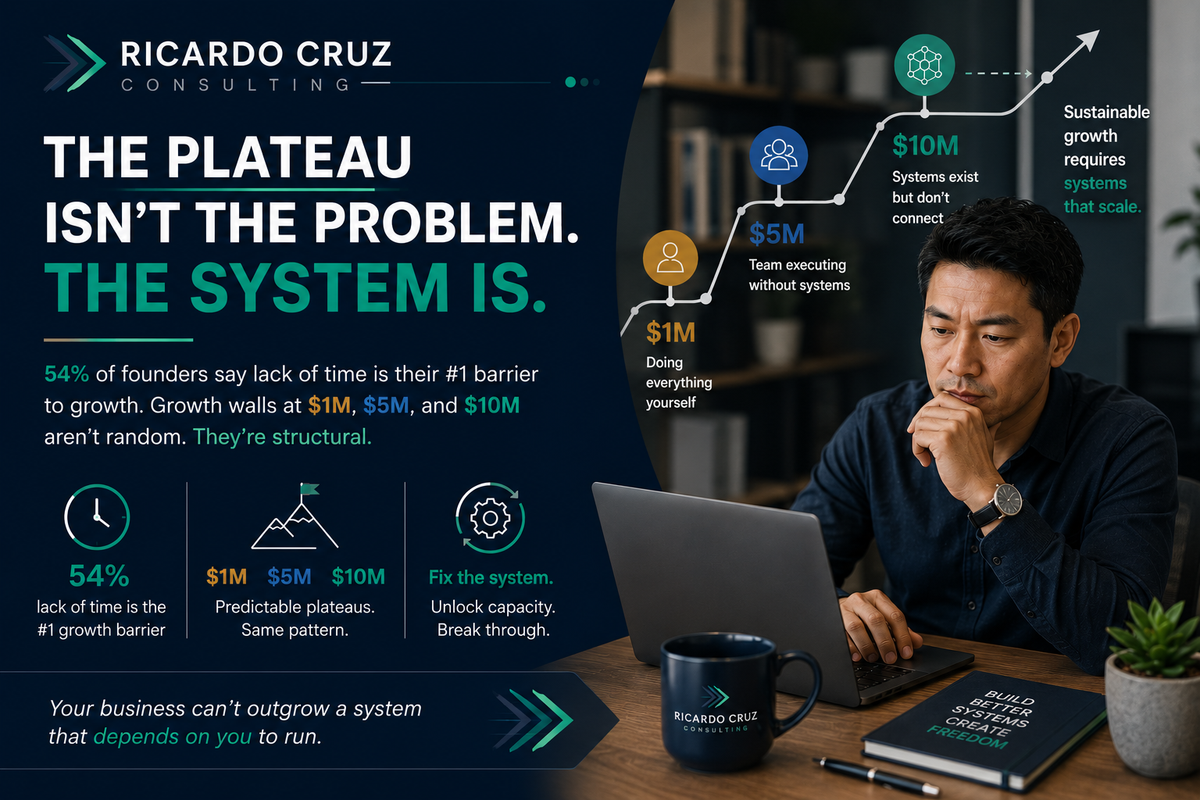
54% of founders say lack of time is their primary barrier to growing the business. Not lack of demand. Not lack of capital. Time. And revenue plateaus, according to the 2026 Small Business Growth Gap Report, cluster around the same predictable points: $1M, $5M, $10M. Over and over, businesses across different industries hit the same walls at the same numbers.
That's not a coincidence. A pattern that consistent isn't about the market. It's structural.
The wall isn't where you think it is
Most founders assume a revenue plateau means they need to sell more, hire more, or market harder. I understand the instinct. Stalled revenue feels like a sales problem, so the response is to push harder on sales.
But here's what I keep seeing when I actually look inside these businesses. The founder isn't out of ideas or out of market. They're out of hours. Every plateau I've diagnosed has the same root cause underneath it: growth requires capacity, and the only capacity available is whatever's left after the founder finishes running the business day to day.
At $1M, the founder is usually doing everything personally: sales, delivery, hiring, putting out fires. At $5M, there's a team now, but the team is executing tasks without real systems underneath them, so quality and speed still depend on the founder checking in constantly. At $10M, systems exist, but they don't talk to each other, so someone (usually still the founder) is the connective tissue holding it all together by hand.
Different symptoms. Same disease. The founder is the operating system, and operating systems don't scale by working harder. They scale by becoming something other people can run.
Why hustle stops working at exactly the moment you need it most
Here's the part that's hard to hear. The instincts that got you from $0 to your current number are the same instincts capping you right now. Hustle and personal involvement built the business. But hustle has a ceiling, and you're at it.
I worked with a service business owner who was convinced her growth problem was a marketing problem. She wasn't getting enough leads, she said. When we actually mapped her week, marketing wasn't the bottleneck. Onboarding was. Every new client required her personal involvement for three separate steps that could've been a form, an automated sequence, and a single approval. She wasn't short on demand. She was short on a system that could absorb the demand she already had.
Once we automated those three steps, she didn't get more leads. She just stopped needing to turn leads away because she didn't have the bandwidth to onboard them properly.
The three things that actually break a plateau
I've found the fix looks different depending on where the wall is, but it always starts in the same place: process before headcount, headcount before tools.
If you're stuck near $1M, the fix usually isn't a new hire yet. It's identifying the two or three things only you can do, and building a repeatable process for everything else so it stops requiring your personal attention.
If you're stuck near $5M, the team probably already exists. The gap is that they're executing without documented systems, which means quality depends on who's doing the task instead of the process itself. This is where SOPs and clear ownership matter more than another hire.
If you're stuck near $10M, the individual systems likely work fine in isolation. The fix is connecting them so information moves automatically instead of through someone manually relaying it between departments.
The question that actually matters
Forget revenue for a second and ask yourself this instead: what would happen to your growth if you personally disappeared for a month? Not what you'd want to happen. What would actually happen.
If the honest answer is "everything would slow down or stop," the plateau isn't a market problem, and it never was. It's a capacity problem wearing a revenue costume, and it breaks the same way every time: by building something that can grow without requiring more of you.
Ricardo Cruz is a Fractional COO and Operations Consultant with 15+ years of enterprise operations experience at Fidelity Investments, including a documented 90% reduction in escalations through process redesign. He works with founder-led service businesses to break through growth plateaus by building systems that don't depend on the founder to run.
Continue exploring
Use the Operational Efficiency guide to identify the capacity constraints beneath a plateau, and the Founder Dependency guide to reduce the founder bottlenecks that often reinforce it.
The Operational Friction Audit provides a structured diagnosis and prioritized improvement roadmap.