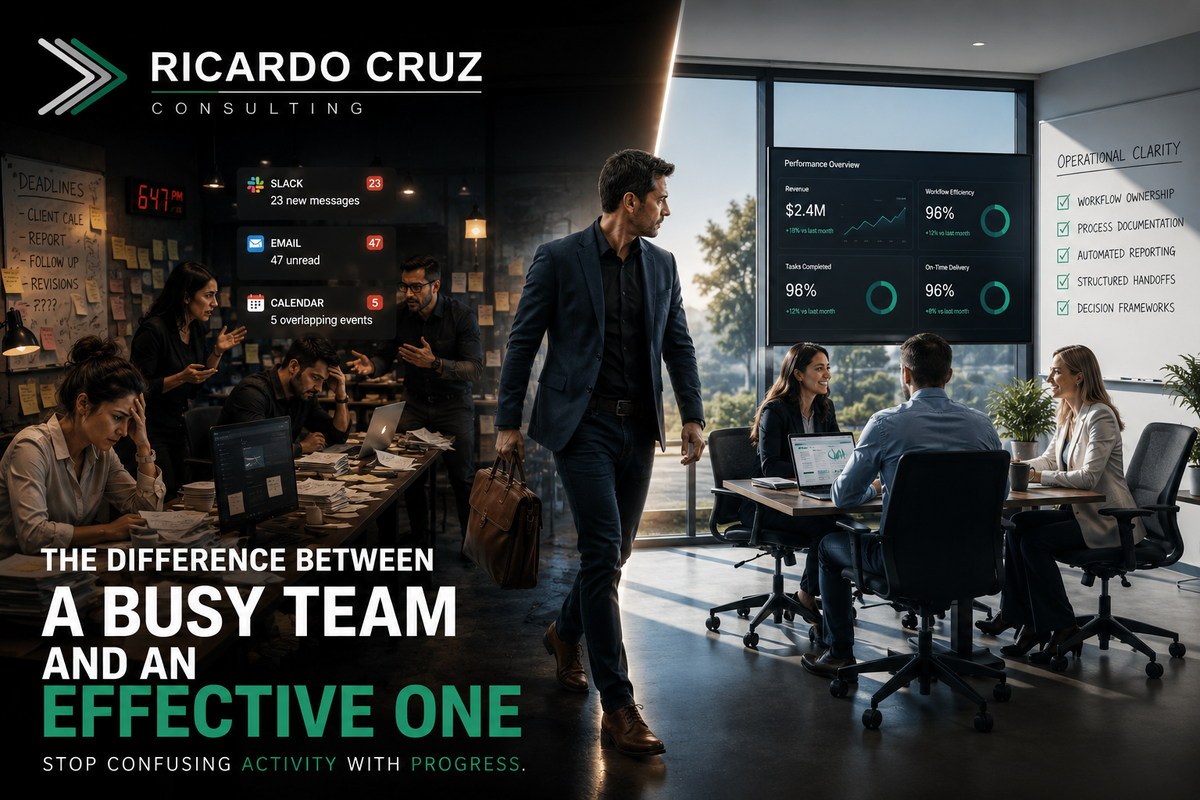
Every founder I have worked with has said some version of the same thing at some point: my team is working constantly, and I still feel like we are falling behind.
That feeling is not a motivation problem. It is not a talent problem. In almost every case, it is a design problem.
There is a meaningful difference between a team that is busy and a team that is effective. Understanding that difference — and being honest about which one you actually have — is usually the first step to building something that grows with less friction.
What Busy Without a System Actually Looks Like
A busy team has full calendars. Slack channels that never quiet down. People who are clearly working hard and clearly tired at the end of the week.
And somehow, the same problems keep showing up.
A report that should take twenty minutes takes two hours because the data lives in three different places and someone has to compile it manually. A client question that should route to one person gets forwarded twice before landing with the right person, too late. An onboarding task that was supposed to happen on day one happens on day five because no one was assigned to track it.
None of these failures are the result of people not working hard enough. They are the result of work that was designed to require constant human effort rather than being designed to run.
When work depends on people remembering things instead of systems doing things, the output does not compound. Every week starts from roughly the same place. The effort stays high. The progress stays incremental.
How Operational Clarity Changes the Nature of Work
An effective team does not necessarily work more hours. It works inside a system that handles the recurring, repeatable parts so the team can spend its time on the things that actually require human judgment.
The distinction sounds simple. The impact is significant.
When the process for handling a client request is documented and followed consistently, the team stops spending time figuring out what to do and starts spending time doing it well. When the handoff between two departments is structured, things stop getting lost and the follow-up conversations stop happening. When reporting is automated, the twenty minutes of actual analysis stops being buried under two hours of data collection.
That is what operational clarity produces. Not more hours in the day — a different quality of work within the hours that already exist.
Three Things to Look at When Your Team Is Busy but Growth Is Stalling
1. Where does information live?
If the answer is 'in people's heads, in email threads, or in a shared folder no one can navigate' — the system is costing you hours you cannot see. Information that is hard to find is information that gets recreated, requested, or worked around constantly.
2. Who owns recurring decisions?
If small decisions consistently require input from a senior person, the decision framework is missing. Every one of those interruptions is a context switch for the person being asked and a delay for the person waiting. Defining ownership explicitly — even for small decisions — removes a significant amount of invisible friction.
3. What does your team do when something goes wrong?
In a well-designed system, a problem traces back to a specific step in a specific process. The step gets fixed. The problem stops recurring. In a poorly designed system, a problem traces back to a person. The person gets corrected. The problem happens again. If you are correcting the same types of mistakes repeatedly, the issue is the system — not the team.
What Changes When the System Handles the Repeatable Work
The shift that happens when operations are designed well is not just efficiency. It is the nature of what people spend their time on.
When the system handles the recurring work, the team handles the meaningful work. The problems that require judgment, creativity, and real skill get the attention they deserve because they are not competing with the manual work that should have been automated or documented months ago.
Growth stops feeling like adding more pressure to an already strained system. It starts feeling like building on something that actually works.
If your team is busy but progress still feels harder than it should, the Growth Capacity Assessment will show you where the operational friction is concentrated and what it is costing. Free. Ten minutes. No email required. Take the Growth Capacity Assessment.
Ricardo Cruz is a Fractional COO and Operations Consultant with 15+ years of enterprise operations experience at Fidelity Investments. He helps founder-led service businesses reduce operational friction, recover capacity, and build systems that can scale without depending on the founder.
Continue exploring
The Operational Efficiency guide explains how to convert effort into capacity, while the Operational Debt guide shows why repeated workarounds keep a busy team from becoming an effective one.